Latest news, analysis and data in the agriculture sector.
news
Feedstock Shortages Force Nigeria’s Cassava Factories to Run Below Capacity
By Chinwendu Ohabughiro | Apr 10, 2026 | 0 comments

News in brief:
-Cassava processing plants in Nigeria are operating at just 30 to 40 per cent capacity due to unreliable supply of fresh cassava tubers.
-Weak farmer supply networks and feedstock instability are undermining investments and threatening the viability of processing factories.
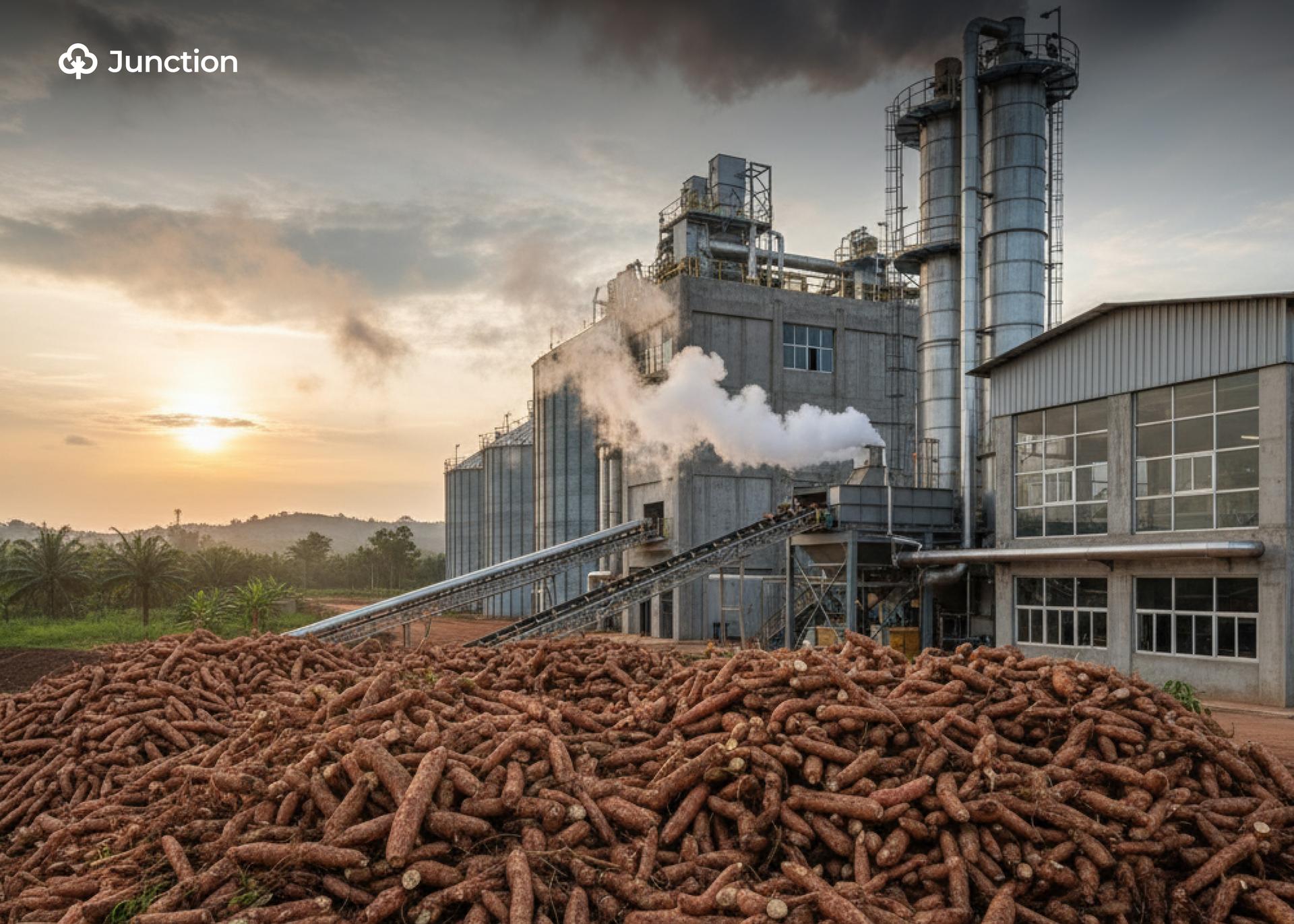
Nigeria’s cassava processing industry is facing a significant challenge as factories struggle to secure enough raw materials, limiting the production of starch, flour, ethanol, and other cassava-derived products.
Despite heavy investment in high-capacity processing plants in recent years, many facilities are operating far below their designed capacity due to the irregular supply of fresh cassava tubers.
Processing Plants Operating Below Capacity
Research by the Nigeria Cassava Investment Accelerator (NCIA) shows that most cassava processing facilities in the country currently operate at between 30 and 40 per cent of their installed capacity.
The findings reveal a widening gap between the growth of processing infrastructure and the availability of reliable feedstock.
While policy initiatives have encouraged investment in industrial cassava processing, the issue of consistent raw material supply remains unresolved, undermining the financial viability of many facilities.
According to NCIA, feedstock reliability is the critical factor determining whether processing plants can perform as intended.
Economic Impact on Processors and Investors
Unreliable cassava supply is placing significant financial pressure on processors. Factories operating at lower capacity still incur full operational costs while generating only a fraction of expected revenue. This weakens profitability, complicates debt servicing, and discourages further investment.
As financial pressure grows, processors often scale back investment in farmer relationships that could improve supply, creating a vicious cycle that perpetuates feedstock shortages.
The impact extends beyond the factories themselves. Downstream businesses relying on cassava products also face disruption when processors cannot maintain consistent production levels.
Market Volatility Across the Cassava Value Chain
The instability in cassava supply is also contributing to price volatility in the market. Periods of surplus can depress cassava prices, squeezing farmers’ incomes. Conversely, when supply tightens, processors face sharply rising input costs.
Both scenarios create uncertainty and weaken confidence across the cassava value chain. NCIA notes that for investors evaluating cassava processing projects, unreliable feedstock supply represents the single largest execution risk.
“A well-structured processing asset with a credible offtake can still be an unattractive investment if feedstock supply is not demonstrably reliable,” the organisation said.
Dependence on Smallholder Farmer Networks
Many processors initially plan to minimise reliance on external farmers by cultivating cassava on company-owned land.
However, findings from NCIA indicate that even vertically integrated processing plants still rely on smallholder farmers for between 60 and 70 per cent of their cassava supply. A mid-sized cassava processing facility typically requires around 3,000 farmers delivering consistently in order to remain viable.
Farmer supply networks can take several forms, including aggregator-led systems, out-grower schemes, and cluster-based coordination models.
However, these systems often struggle due to complex logistics, weak coordination, and limited investment in supply chain management.
The Block Farming Model
Since 2014, the Sustainable Trade Initiative (IDH) has been testing a structured approach known as the block farming model.
The system organises smallholder farmers into coordinated production blocks centred around a focal farm. Farmers receive access to inputs, financing, and technical support, while production schedules are aligned with processor demand.
The model also introduces phased cropping systems that help smooth supply flows to factories rather than delivering cassava in seasonal surges.
According to NCIA, farmers participating in the programme achieved yields 57 per cent higher than the national average and saw incomes increase by 81 per cent. Farmers in surrounding communities also experienced a 15 per cent rise in income.
Scaling Challenges and Trust Issues
Despite its success, scaling the block farming model nationally presents several operational challenges.
For example, it involves land consolidation at scale, sustained financing for inputs, management capacity, logistics, and the perishability of cassava tubers.
Another persistent issue is side-selling, where farmers sell their harvest to alternative buyers instead of contracted processors.
To address this, experts say processors must improve payment timelines and introduce loyalty mechanisms that strengthen trust with farmers.
Industry stakeholders suggest measures such as transparent pricing frameworks, end-of-season performance incentives, structured input-credit recovery systems, and group accountability models.
Shifting Focus from Factories to Farms
Experts argue that the economics of cassava processing depend heavily on factory utilisation rates.
Increasing plant utilisation from 40 per cent to around 80 per cent could mark the difference between financial losses and long-term viability for many processors.
Achieving that level of utilisation will depend largely on building strong and reliable farmer supply networks.
Stakeholders say strengthening these networks offers a faster and more controllable solution than relying on technological breakthroughs or policy reforms.
By focusing on the farm as much as the factory, Nigeria’s cassava industry could unlock its full potential and support multiple industrial applications, ranging from food products such as garri to industrial uses, including bioethanol.

Chinwendu Ohabughiro
Chinwendu Gift Ohabughiro is a Lagos-based content writer and communications specialist passionate about people-centered stories that inspire change. A lifelong learner, she loves exploring languages, culture, storytelling—and anything involving chocolate.
Comments
More Articles Like This


