Latest news, analysis and data in the agriculture sector.
spotlight
How a Farmer's Fish Hatchery is Powering Farms in Ogun, Lagos
By Chinwendu Ohabughiro | Apr 14, 2026 | 0 comments

Fish is an essential part of the Nigerian diet, and Nigerians can’t get enough of it. As a good and affordable source of protein, fish makes up 40% of the nation’s animal protein intake and local demand is estimated at over 3.3 million metric tonnes annually, but the local supply is not enough.
Despite the country being the largest producer of farmed catfish in the world, producing roughly one million metric tonnes annually, Nigeria spends approximately $1 billion every year importing fish to fill the supply gap for local demand. This has made the fish farming sector an obvious, lucrative agricultural value chain that a lot of young Nigerians are venturing into. Many of them operate at different small-scale levels at various points of the fish rearing value chain.
One of these enterprising Nigerian youth is Grace Okeolajide, a 27-year-old fish farmer who has carved out a space for herself in the most technical aspect of the fish farming value chain.
Grace, the Catfish Gynea
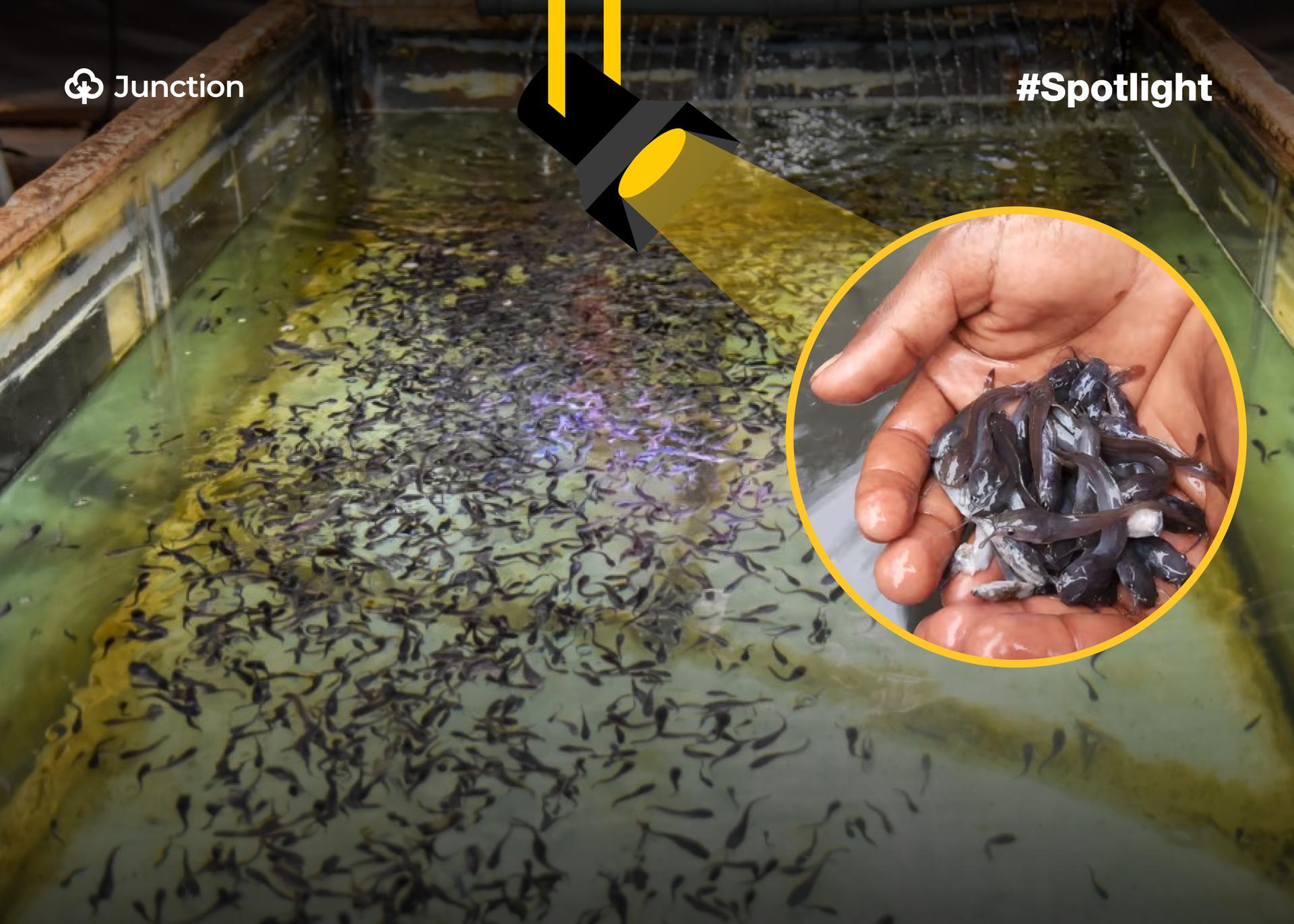
As the co-founder and operational heart of Adeola Agriculture Venture, a catfish hatchery and fish farming company in Ogun state, Grace is in charge of reproducing catfish.
Like a regular gynaecologist, her daily work involves spawning catfish fries. "When I just spawn, it's like giving birth to a new baby. Literally," she says, betraying her passion and commitment to the work.
Tucked into a residential compound off Akute Area in Ifo local government of Ogun State, a town sitting at the edge of Lagos's sprawling reach, Grace offers a unique service that plugs a critical gap in the fish farming value chain.
Fish hatching is the most technical, demanding, and unforgiving part of the entire catfish production chain. It is the part that most other farmers pay to avoid. Many farmers, even large-scale ones, prefer to raise fish from juveniles or fingerlings to table size to avoid the stress that Grace deals with daily.
As she admitted, it is not an easy task. It is work that involves waking at 2 AM, when most people are still asleep, to pull waste from the pond floor, ensure clean water is running in the pond to keep the thousands of tiny lives she brought into the world just days before safe and healthy. Her work denies her a lot of needed sleep, but she forges on her chosen path, chesting the challenges and welcoming the wins equally. From experiencing three failed batches when she was starting, the hatchery has grown into one that keeps a steady queue of customers waiting before she has even finished selling the current batch.
Grace’s journey didn’t start conventionally; it started
From Grief to Ground
In 2020, Grace’s husband lost his mother before the world went into lockdown. During the lockdown, there was nowhere to go, nothing to fill the silence with, no routine to hold on to. So they started planting vegetables, not to sell, just to feel the ground beneath their hands, to watch something grow when everything else felt like it was shrinking.
"It was therapy," she says simply.
Their organic produce, grown with pig manure rather than chemical fertiliser, caught the attention of neighbours, then market women. The hobby became a business. The business grew roots. And then one evening, her husband came home from buying juvenile fish and told her about a woman who operates a fish hatchery from a compound smaller than theirs. He said that although he could not manage that kind of operation himself, he believed she could.
"I will never forget that conversation," Grace says.
She visited the woman in November 2020. Her husband paid upfront for her lessons. She stayed and learned. Less than four years later, she runs her own hatchery, the hardest part of the chain, and she runs it well.
A Day That Starts Before Dawn
On a standard morning, once the critical newborn period has passed, Grace arrives at the ponds between 4 AM and 6 AM. The work is methodical and physical: siphoning waste from the pond floor, sorting fish by size, washing the tanks, and treating the water. She treats the water as regularly as every two days, and on alternate days, she changes the water entirely.
The reason she sometimes works at midnight is the same reason she cannot afford to miss a water change: without electricity, she can not pump water. Without pumping water, there is no fresh water, which the fish need to live. In Nigeria, where power supply can vanish for hours without warning, she quickly learns to work around the grid rather than with it.
Her hatchery produces juveniles and fingerlings, which she sells directly to other fish farmers within eight weeks of spawning. For the larger, table-size fish she also raises, the cycle runs for four to five months, at which point each fish reaches about one kilogram, which is faster than the six months many other farmers require.
The Quiet Link in the Food Chain
There is a reason her customers often join a waitlist for each batch. Spawning catfish is not something every farmer can do. It requires precision in water chemistry, exact treatment measurements, patience through the unpredictable, and the willingness to wake at odd hours on some days.
Grace learned this the hard way, with three failed production batches before getting the measurements right, further showing why many farmers skip the process entirely and buy juveniles from someone like her.
This is where her role in the food chain becomes quietly significant. African catfish accounts for more than half of Nigeria's total aquaculture output, and demand for live catfish has grown steadily as more Nigerians eat away from home, at restaurants, pepper soup joints, barbecue spots, and hotels. Every juvenile Grace sells to another farmer is a future fish on someone's plate. Every batch she spawns is a link in a chain that runs from her pond by the wee hours to a bowl of catfish pepper soup somewhere across Lagos by sundown.
The Weight of Feed and Light
Feed cost is the heaviest burden in fish farming. Grace imports specialised feeds for her hatchery stock; these premium inputs come at high prices that are always increasing.
"You go to the market today and hear the price of feed," she says, "then go back the next day, and it's another crazy price."
She manages this by adjusting her pricing, offering customers different size categories at different price points, absorbing some of the cost without losing customers due to sudden increases. It is a tightrope, and she walks it every cycle.
Then there is the cost of electricity and space. Early on, when a batch performed better than expected, she ran out of ponds to spread the fish, and overcrowding accelerated mortality. So, a good harvest, ironically, became a crisis.
Grace has since expanded, but the memory sharpens her planning.
She partly credits her husband's financial and moral support for her continued drive to succeed. Also, she says that she is passion-driven, which is important in running this kind of venture.
"If you are not passion-driven," she tells anyone who asks about the business, "you will drop it in the next one, two, three months."
Building a Frontier, Not Just a Farm
Grace uses social media to show what fish farming actually looks like, not the finished product heading to market, but the process. She reveals that people still stop her mid-conversation when she mentions what she does. They want to know everything, she states, when she mentions that she specifically mentions that she is involved in catfish reproduction. It is rare, they tell her, and she agrees, and keeps going anyway.
She gives consultations and trains people who reach out. She answers messages from aspiring farmers who had no idea how fish were even brought into the world before they found her page. She is building something beyond a business.
"Agriculture is the new oil money," she says, and she means it as more than a slogan. She wants younger Nigerians, especially young women, to stop seeing the farm as a fallback and start seeing it as a frontier.
The barriers are real, she acknowledges: the capital intensity, the absence of support systems, the 9-to-5 mindset that hardens in people before they ever consider another path. However, she has navigated all of it, and she does not see why others cannot.

Chinwendu Ohabughiro
Chinwendu Gift Ohabughiro is a Lagos-based content writer and communications specialist passionate about people-centered stories that inspire change. A lifelong learner, she loves exploring languages, culture, storytelling—and anything involving chocolate.
Comments
More Articles Like This


