Latest news, analysis and data in the agriculture sector.
Loading...
Loading...
Connect With Us On Social Media


+2347026896031
info@tao.com.ng
spotlight
By Chinwendu Ohabughiro | Sep 21, 2026 | 0 comments


Nigeria faces a twin problem with food waste: we generate too much, and it costs too much to dispose of. Food waste starts accumulating before it even reaches the market because of bad roads, poor transport infrastructure and non-standard vehicles.
Common sights at our markets include bruised tomatoes, wilted vegetable leaves, spoilt fruits and tubers, and their peels are already piled up for collectors. By evening, restaurants and homes add their own leftovers, bones, scrapings, and other ends of things nobody wants.
Together with waste from other sources, we have the gigantic waste heaps seen across dumpsites in Nigeria.
Disposing of this waste responsibly costs an arm, and not doing it causes even more harm.
However, what if this waste can do more than fill dumpyards?
That is the question Akorede Salaam, an animal scientist and regenerative farming expert, is answering.
Nigeria wastes an estimated 38 million tonnes of food annually, more than any other African nation, a figure the European Union's deputy envoy to Nigeria cited at this year's International Zero Waste Day. A 2024 UNEP Food Waste Index Report separately found Nigerian households waste about 113kg of food per person a year, the highest household total in Sub-Saharan Africa. BusinessDay Nigeria puts the broader figure, including post-harvest losses, at closer to 40 per cent of total food production lost annually.
For Salaam, the scale of this problem calls for a redesigned approach that moves away from the costly norm of filling up dumpsites and constantly looking for a cheaper collector or another nearby dumpsite.
With years of experience as a farmer, an animal science degree and a postgraduate specialisation in environmental sustainability, he believes he has found an answer through regenerative agriculture.
Regenerative agriculture is an alternative to industrial farming that emphasises restoring and enhancing ecosystems rather than merely sustaining them. It treats soil, water, plants, animals, and people as interconnected parts of a living system.
Salaam’s work involves composting food waste into fertiliser, turning crop residue into silage and, most importantly, feeding organic food waste to Black Soldier Fly larvae raised for livestock feed.
His work at NexGen Ceres Ltd, a Lagos-based agricultural consultancy, focuses on one of the four key regenerative agriculture practices: the nutrient cycle, which ensures continuous flow of nutrients between living creatures and non-living materials through the mineral cycle. Waste transformation does this by regenerating nutrients from non-living materials and redistributing them to plants and animals that will eventually feed humans, who continue the cycle by generating more waste.
Beyond regenerative practice, it is also a sustainable system, where composting turns crop residue into slow-release fertiliser, cutting farms' need for imported inputs, and silage lets cattle and small ruminants feed through the dry season without expanding grazing land. In his account, these reduce the farm's carbon footprint and make it more sustainable because sustainability isn't just about avoiding synthetic inputs, but accounting for a resource's full lifecycle.
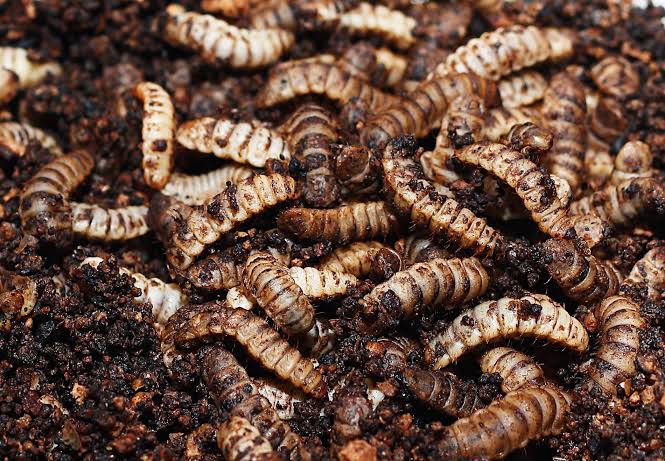
The insect at the centre of Salaam's work is the Black Soldier Fly, whose larvae digest organic waste at speed. They are omnivores that consume fruit and vegetable peels, spoiled produce, abattoir waste, even restaurant scraps, converting them within two to three weeks into two products: a larval biomass rich enough in protein to replace fishmeal and soybean meal in feed, and a residue called frass that works as organic fertiliser. Researchers estimate the larvae's crude protein content at 40 to 60 per cent. At the Africa Agriculture Science Week in Abuja, one scientist described larvae harvested within 14 to 21 days, alongside insect oil and fertiliser, as by-products.
Nigeria's own institutions have begun to notice the importance of this system. For example, at a national roundtable hosted by the International Livestock Research Institute in Ibadan this year, stakeholders in Nigeria's feed and BSF sector called for policy reform, investment and research coordination to scale insect protein, noting that similar circular models elsewhere have reduced dependence on fishmeal while improving productivity.
"Farmers that deal with manure will deal with anything, to be honest. If they can survive that, they can survive anything," Salam said in one of his interviews.
Describing a recent project he worked on for a poultry and fish operation in Abuja, he recalled how his team built an "insect materialisation system" converting animal mortalities into insect protein for the farm's fish. Within three months, the unit had generated fertiliser for the greenhouse, feed for the fish, and a measurable drop in what the farm counted as pure loss.
"They don't really count mortality as total loss these days," he says, "because they know the value they can take out of it."
Salaam's longer-term case rests on demographics as much as biotechnology. Nigeria's population is growing, meaning food demand and waste generation will both keep rising regardless of policy. He argues the more resilient farms will be those already built to absorb that waste through compost sites, greenhouses and insect units already spreading informally across farming communities.
"Nigerians are very quick to get on a bandwagon like this," he says, pointing to how quickly composting and small-scale insect farming have moved from novelty to normal.
He hopes for a genuinely circular food system where waste doesn't leave the system but re-enters it as feed, fertiliser or fuel.
The urgency here is arithmetic as much as ideology. Feed already accounts for most production costs in Nigerian poultry and aquaculture, and it has worsened sharply.
A report claimed that fish feed prices rose from ₦18,000 to ₦36,000 for a 15kg bag between 2023 and 2024, driven by maize and soybean costs that more than doubled. The Poultry Association of Nigeria (PAN) says roughly half the country's poultry farmers have shut down amid rising input costs. Set that against Nigeria's food waste numbers, and waste valorisation looks less like idealism and more like supply-chain logic: a farm losing money to feed, next to a market losing food to spoilage, has an obvious, underused fix in the middle.

Chinwendu Gift Ohabughiro is a Lagos-based content writer and communications specialist passionate about people-centered stories that inspire change. A lifelong learner, she loves exploring languages, culture, storytelling—and anything involving chocolate.