Latest news, analysis and data in the agriculture sector.
farming
How to Use Crop Rotation for Pest and Disease Management in Nigeria
By Noah Aderoju | Mar 06, 2026 | 0 comments

Many farmers see crop rotation as an old farming method that no longer fits into modern practice, but this centuries-old cultural control method is a practical and cost-effective strategy for farmers to manage pests and diseases on farmlands.
Long before chemicals and pesticides became popular, farmers relied on crop rotation to protect their crops, improve soil health, and increase yield. With a good understanding of crop traits and their associated issues, farmers can strategically leverage rotating their cultivation to benefit the farm land. This method is especially more recommendable as an integrated pest management strategy with the rising cost of chemicals and cases of pesticide resistance.
In this article, we will explore what crop rotation is, how it can control pests and diseases on farmlands, and how Nigerian farmers can use it practically for better harvests.
What Is Crop Rotation?
Crop rotation is simply the practice of planting different crops on the same piece of land in different farming seasons or years instead of planting the same crop continuously.
This practice has several benefits to the farmer, from tackling soil degradation, infertility and erosion to increasing yield and managing pest and disease outbreaks on farms. In the case of pest and disease management, it helps to eliminate or reduce the presence of pathogens, insects, and weeds common to a certain crop on the farmland.
Practically, a farmer splits his/her portion of land into four to rotate the planting of four different crops yearly across each portion. For example, in the first year, he could plant Maize in Plot 1, Beans in Plot 2, Cassava in Plot 3 and Groundnut in Plot 4. By the second farming year, he changes the crop planted on each plot of land to one of the four different crops.
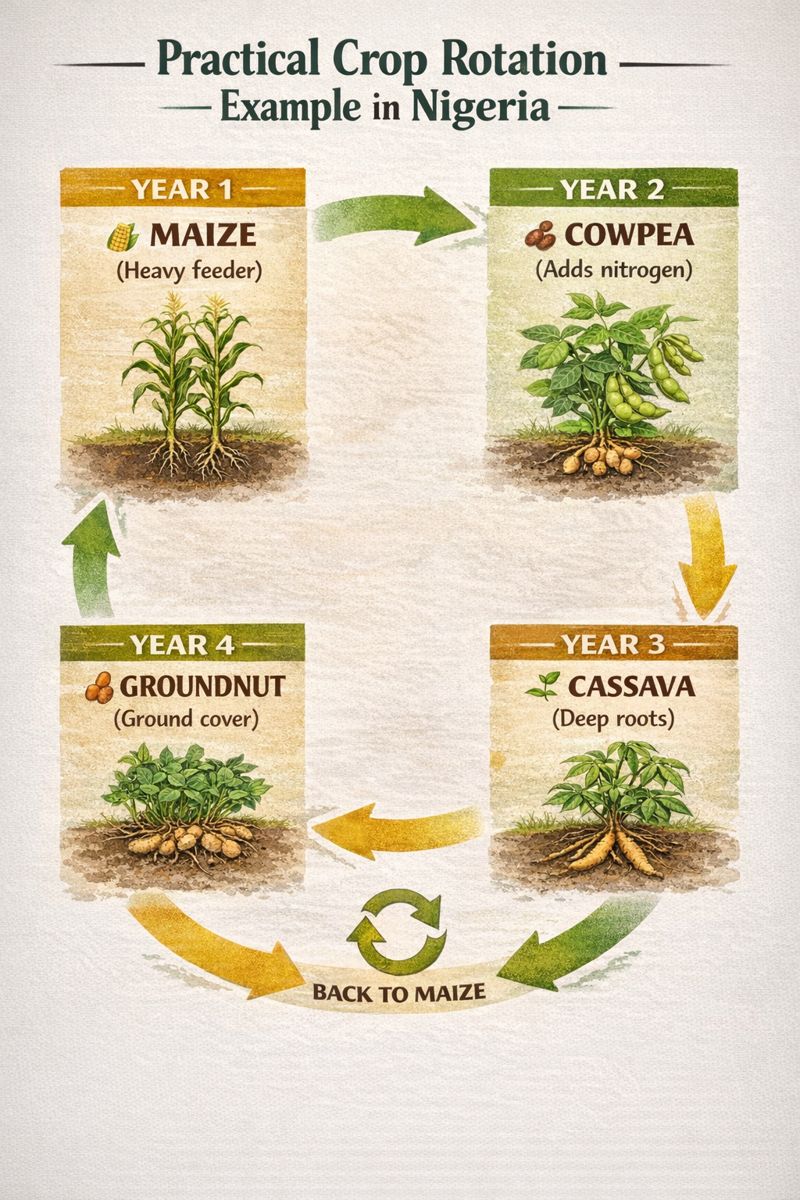
The farmer continues in this order, making sure that he/she doesn't plant the same crop on a plot until the next four years.
Why Crop Rotation Is Important for Nigerian Farmers
Crop rotation has several benefits, especially to Nigerian farmers who have access to one of the most arable lands in the world capable of growing different crops. Some benefits include:
- Reducing pests and diseases naturally by removing their source of sustenance.
- Improving soil fertility by leveraging the traits of crops to increase the deposition of nutrients to the soil.
- Reducing weed pressure with the strategic planting of weed-eliminating crops at intervals.
- Increasing crop yield with deposited nutrients from the previously planted crop.
- Spending less money on chemicals and fertilisers through the use of cultural pest control methods.
How Crop Rotation Controls Pests and Diseases
Most pests and diseases survive because their favourite crop is planted every year. When the crop changes, the pest usually has nothing to feed on and dies naturally. This is where the technical know-how of crop rotation is very important. Just rotating any kind of crop will not give you the best result.
To maximise the effectiveness of crop rotation, farmers must understand the underlying biological principles that allow it to function as a pest control tool. Some foundational principles behind using crop rotation as a pest control method include the following.
1. Breaking Pest and Disease Life Cycles
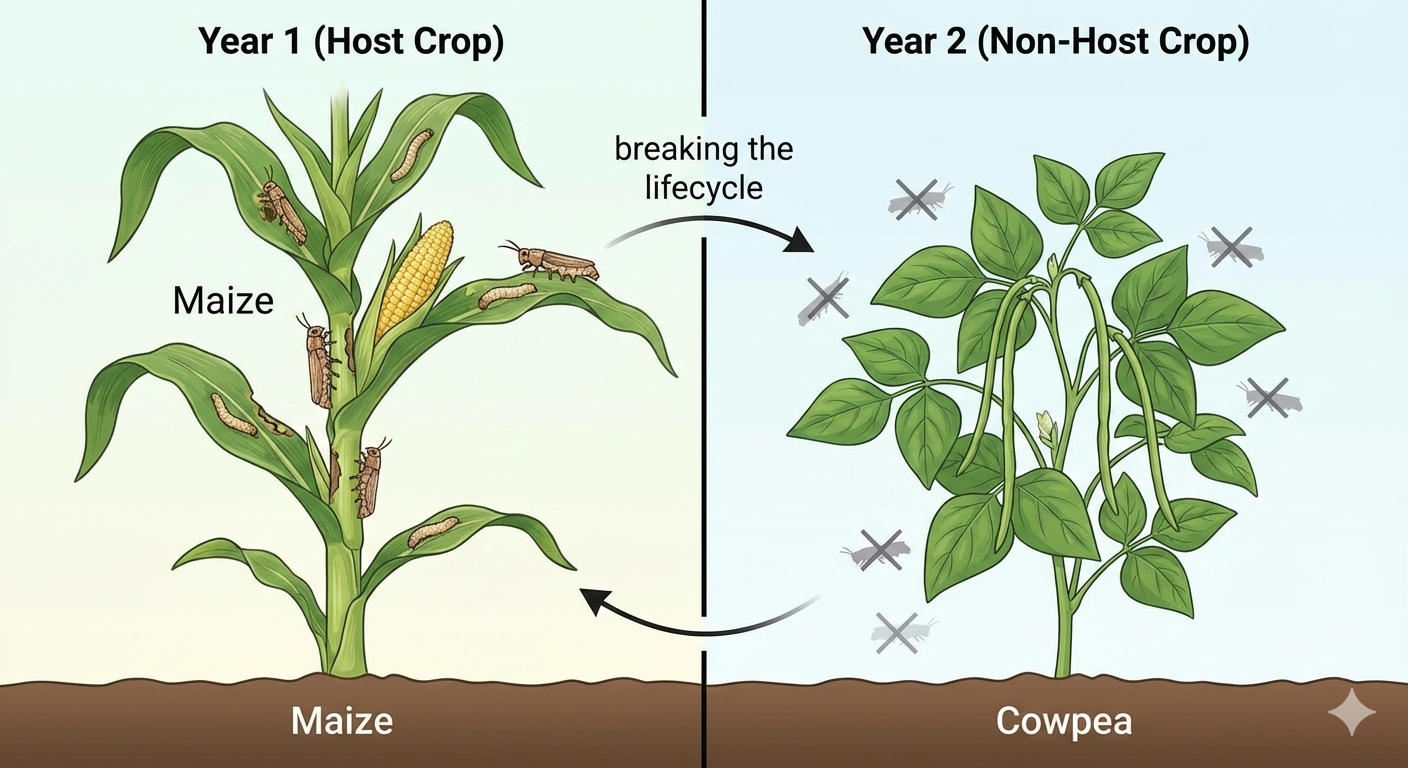
One way crop rotation helps to manage pest outbreaks is to break the natural lifecycle of the pest population in a farmland. Many pests, fungi, and bacteria depend on one specific crop to survive because of certain components that serve as their own sustenance.
When a farmer plants a different crop which does not provide sustenance (a Non-Host crop), the pest cannot find food, it cannot multiply, and its population usually reduces after 2–3 seasons. That is why a 4-year rotation cycle is the standard and mostly recommended duration for crop rotation.
A simple example is**** planting beans after maize, which helps control maize stem borers because the insect cannot survive on legumes.
2. Confusing Weeds and Reducing Their Growth
Planting the same crop every year allows certain weeds to adapt and dominate the farm. With crop rotation, a farmer can create a complex and unpredictable pattern of disturbance that "keeps the weeds guessing". By planting a different crop, the planting time changes, the land preparation (soil disturbance) and other factors on the farmland change, which then confuse weeds and prevent them from reproducing successfully.
3. Natural Pests and Weeds-Suppressing Crops
Some plants, due to their biological component, naturally release chemicals that reduce weed growth. This is called allelopathic interference, where certain plants release natural chemicals during their growth or decomposition that inhibit the germination and growth of other plants, particularly weeds.
Some crops like Sweet Potato, Cowpea, and Pumpkin, which spread fast and block sunlight from weeds, can achieve this effect, helping farmers to reduce weeding or use of herbicides.
4. Crop Rotation is not an Almighty Formula
While crop rotation is effective, it is not a universal solution. Its effectiveness is limited by three main factors:
- Wide Host Ranges: Pathogens like Rhizoctonia solani, Sclerotium rolfsii, and Pythium species can infect so many different types of plants that finding a suitable rotation crop is difficult.
- Mobility: Many adult insects are highly mobile and can simply fly into a new field from overwintering sites, meaning year-to-year rotation may not affect them.
- Persistence: Some pests can actually survive in the soil for decades. For example, while clubroot can persist for seven years, white rot of Alliums can survive as sclerotia for over 50 years.
That is why rotation must be combined with other IPM methods and good farm hygiene and clean planting materials, to avoid unintentionally transporting pests and diseases to a good farmland
Important Crop Rotation Rules Every Nigerian Farmer Must Follow
1. Never Rotate Crops From the Same Family
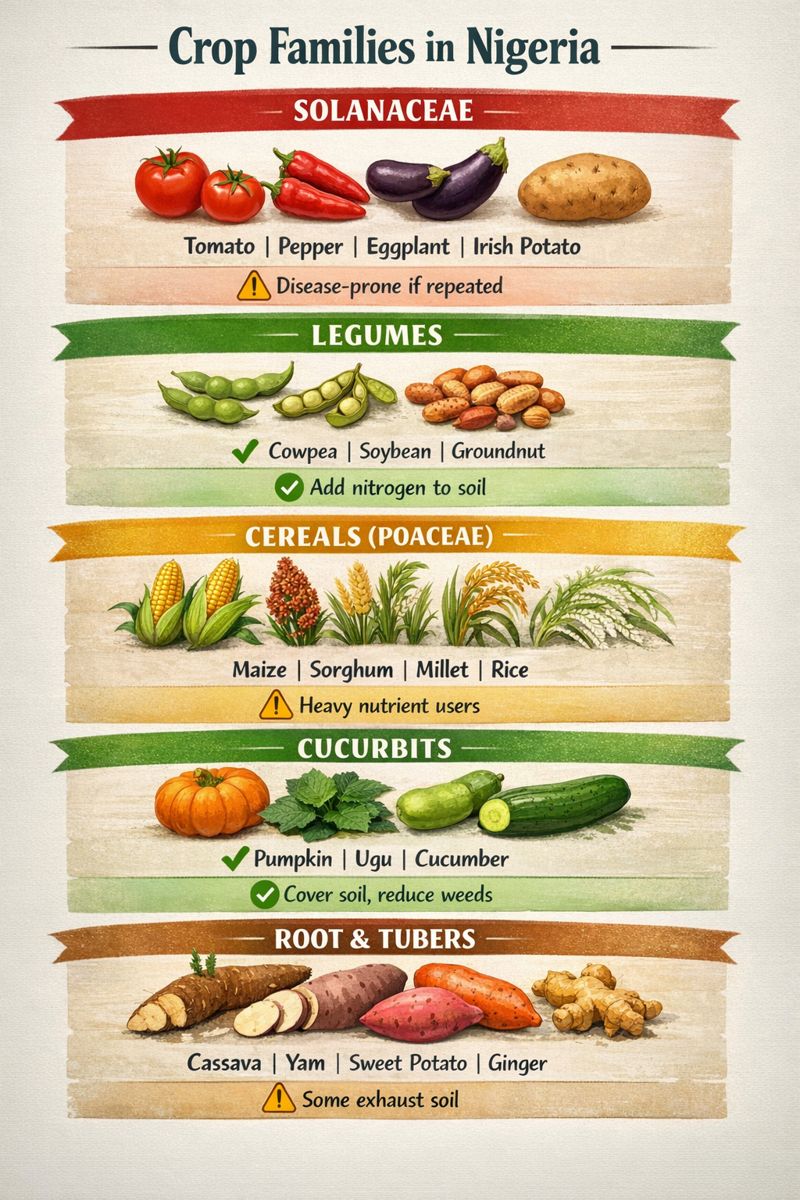
Crops from the same family share the same pests and diseases.**** This is why farmers practising crop rotation must not plant crops from the same family or those that share the same pest or disease on the same land in consecutive years.
Example: Crops like Tomatoes, Peppers, Eggplants, and Irish Potatoes are highly susceptible to Ralstonia solanacearum, the bacterium causing Bacterial Wilt. So, if you plant ginger after tomatoes, the small amount of bacteria left by the tomatoes will "explode" in population, causing the ginger rhizomes to rot into a smelly, watery mess.
2. Always Follow Cereals With Legumes
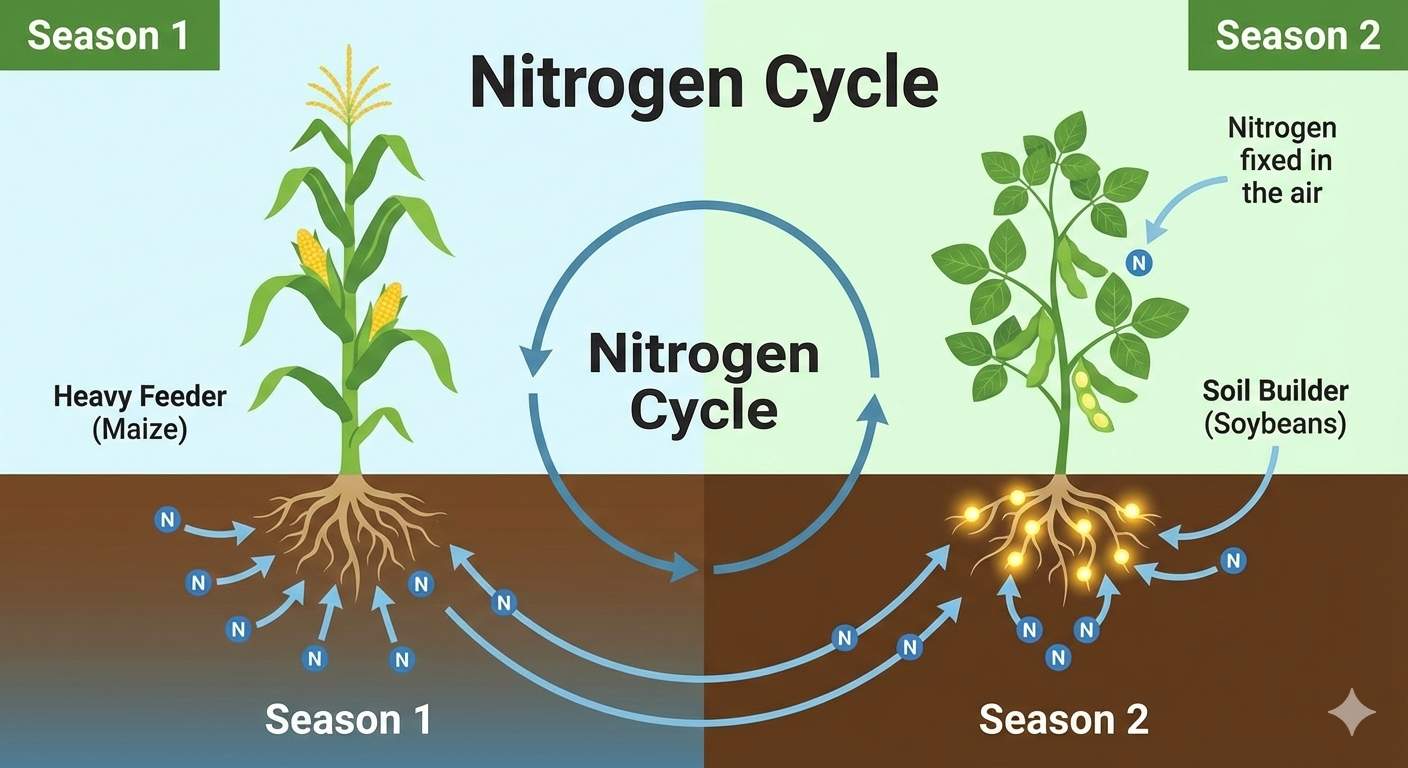
Cereals like maize, Sorghum and Millet use a lot of nitrogen from the soil; this is why they are called “heavy feeders”. While Legumes like soybeans, cowpea and groundnut, called “Soil builders”, return nitrogen back to the soil naturally. Leveraging the traits of these different categories and following a cereal crop with a legume will replenish soil nutrients naturally and reduce fertiliser costs.
3. Alternate Deep-Rooted and Shallow-Rooted Crops
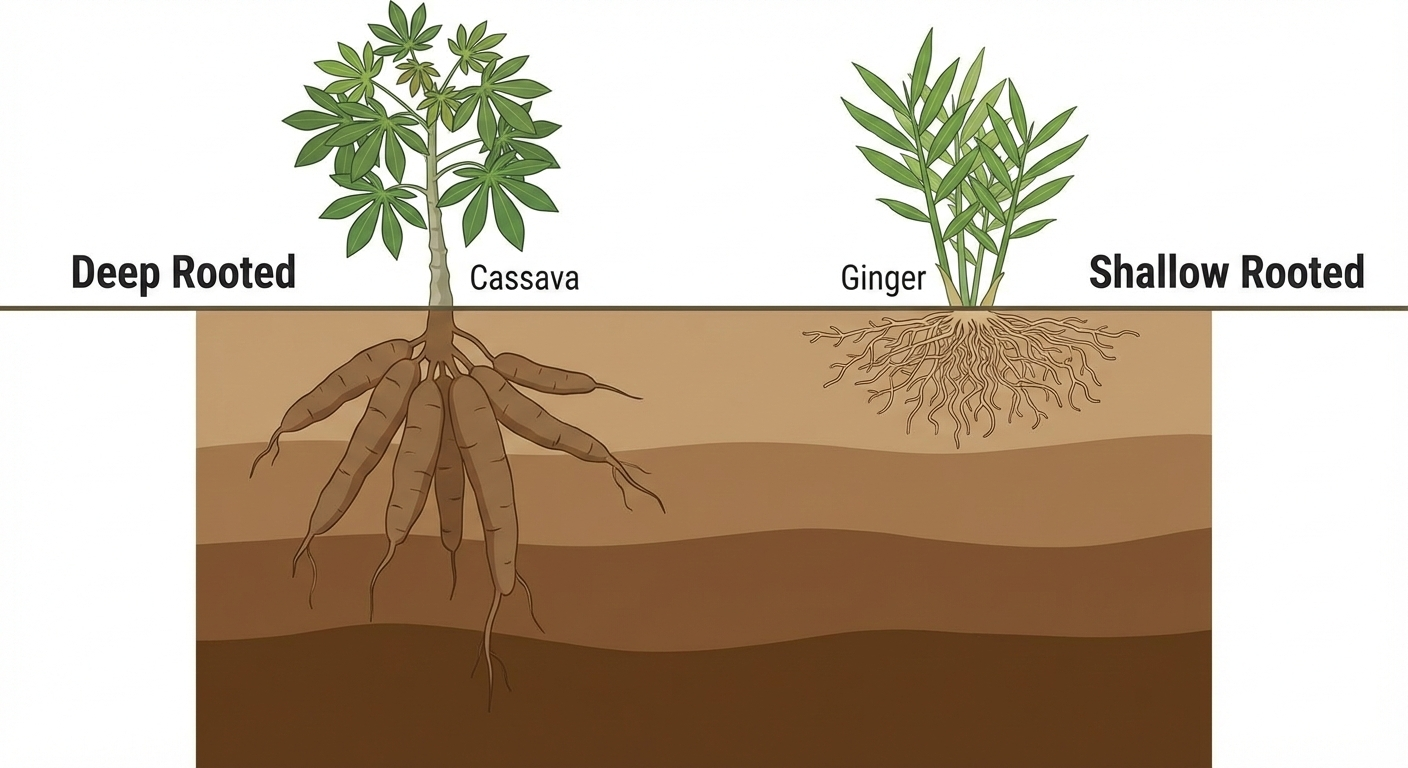
Different crops feed at different soil depths because of the kinds of roots they have. Alternating Deep-rooted crops like Cassava and Sesame with Shallow-rooted crops like Maize and ginger prevents soil nutrient loss and compaction and ensures the entire soil profile is used efficiently.
4. Use Cover Crops to Control Weeds
Good cover crops like Sweet potato, Pumpkin and cowpea act as living mulch, reducing the labour needed for weeding in subsequent years. So, it is recommended that before planting crops that suffer from weeds (like ginger), plant crops that cover the soil well.
Practical Crop Rotation Examples in Nigeria
Nigeria's diverse agro-ecological zones require specific rotation formulas to address local pests and soil conditions.
1. The "Middle Belt" Generalist Formula
In the Middle Belt, farmers often balance grain production with root crops.
- Year 1: Maize (Heavy feeder/Cereal).
- Year 2: Cowpea (Nitrogen fixer to restore soil after maize).
- Year 3: Cassava (Deep-rooted "tiller" to break up compacted soil).
- Year 4: Groundnut (Ground cover to prevent erosion and suppress weeds).
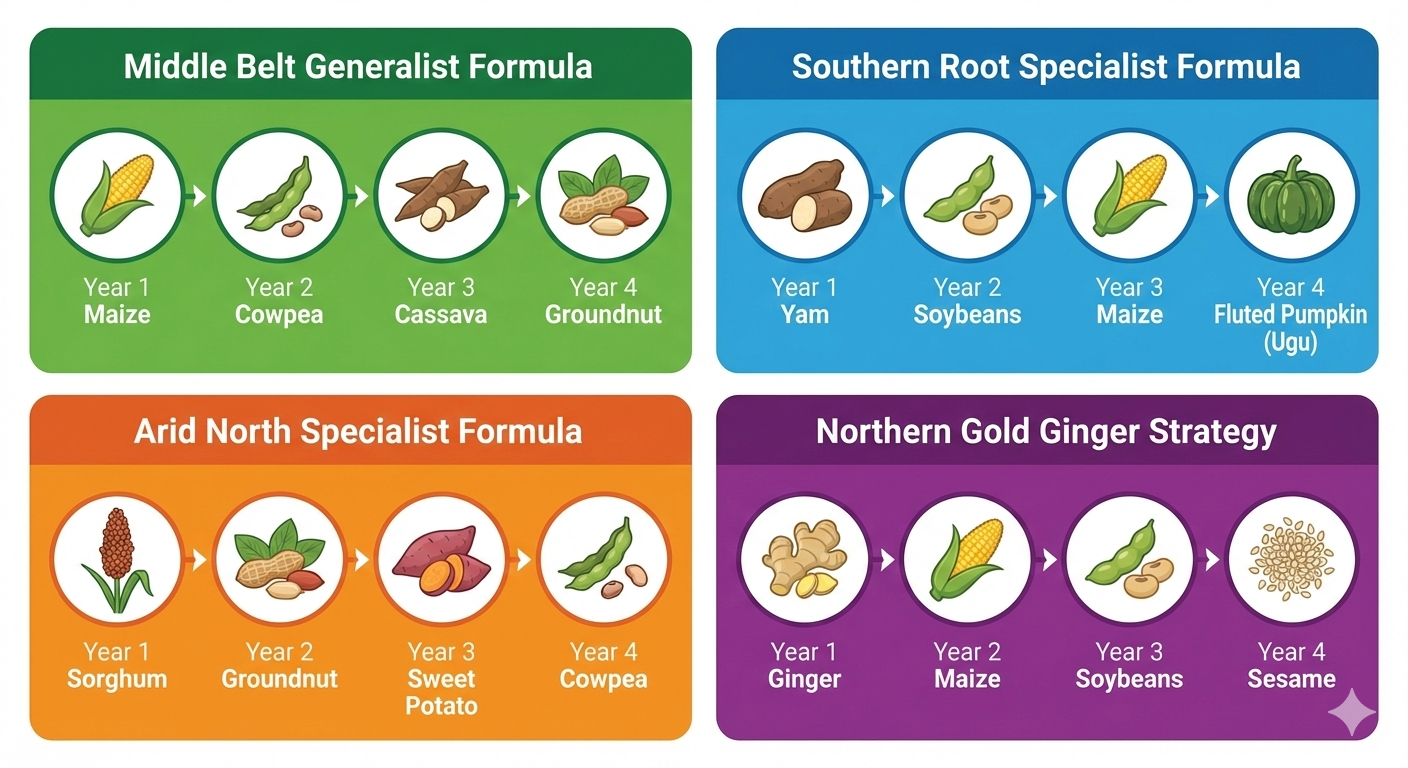
2. The "Southern Root" Specialist Formula
Southern farmers must manage high rainfall and soil-borne pests like nematodes.
- Year 1: Yam (High-value, prestige crop that consumes heavy nutrients).
- Year 2: Soybeans (Used immediately after yam to restore soil fertility).
- Year 3: Maize (Cereal crop; provides a "disease break" from yam pests).
- Year 4: Fluted Pumpkin (Ugu) (Leafy vegetable that provides quick cash flow and covers the soil).
3. The "Arid North" Specialist Formula
In the North, drought resilience and weed control are the priorities.
- Year 1: Sorghum (Drought-tolerant cereal).
- Year 2: Groundnut (Legume for nitrogen and ground cover).
- Year 3: Sweet Potato (Acts as a "living mulch" to smother weeds).
- Year 4: Cowpea (Additional nitrogen fixation and food security).
4. The "Northern Gold" Ginger Strategy
For farmers in Southern Kaduna, rotation is the most effective defence against Bacterial Wilt.**** Ginger is an "exhaustive" crop that should only return to the same plot every four years.
- Year 1: Ginger (High value; requires heavy fertilisation).
- Year 2: Maize (The "Heavy Cleaner" that mops up residual fertiliser left by ginger).
- Year 3: Soybeans (The "Restorer" that fixes nitrogen for the tired soil).
- Year 4: Sesame (The "Deep Tiller" that brings deep nutrients to the surface and survives the end of the rainy season).
Implementation and Best Practices for Nigerian Farmers
To successfully implement these rotations, Nigerian farmers should adopt the following management strategies:
Divide the Land: Farmland should be divided into four equal sections or plots. Even small-scale farmers with only one hectare should divide their land into four strips to maintain the cycle.
Maintain Hygiene: Crop rotation can be undermined by poor sanitation. Bacterial Wilt and other pathogens travel in the mud on boots, hoes, and tractor tyres. Farmers should wash tools with a mixture of water and bleach (Jik) when moving from a potentially infected plot to a clean one.
Seed Selection: Never use "seeds" or rhizomes from a farm that showed signs of disease in the previous year. Using clean, certified seed is essential to ensure the rotation starts on a pest-free foundation.
Use Natural Enhancements: In regions like Northern Nigeria, applying**** Neem Cake during planting can act as a natural pesticide against soil nematodes. Nematodes often wound plant roots, creating entry points for the very diseases crop rotation is intended to prevent.
Manage Competition: In designing the sequence, always follow a poor competitor crop with a strong competitor. If weeds have become a serious barrier, alternating non-competitive crops with aggressive growers like potatoes or soybeans can help regain control of the field.
Final Thoughts
Crop rotation is not an outdated farming method; it is a smart farming system rooted in ancient traditional knowledge. When combined with modern technical knowledge of crop components and pest behavioural patterns, it can be a very innovative and sustainable farming practice.
By strictly adhering to botanical family separations and alternating nutrient demands, Nigerian farmers can create a sustainable agricultural system that naturally suppresses pests, reduces the need for expensive chemical inputs, and protects long-term soil health.

Noah Aderoju
Noah Aderoju is a multimedia journalist and researcher with a passion for telling stories.
Comments
More Articles Like This


